|
Oxford first occupied in Saxon times,
and was initially known as "Oxenaforda". It
began with the foundations of St Frideswide's nunnery
in the 8th century, and was first mentioned in written
records in the Anglo-Saxon Chronicle for the year 912.
In the 10th century Oxford became an important military
frontier town between the kingdoms of Mercia and Wessex
and was on several occasions raided by Danes. St Frideswide
is the patron saint of both the city and university.
Oxford grew up under the shadow of a convent, said to
have been founded by St Frideswide] as early as the
eighth century. Its authentic history begins in 912,
when it was occupied by Edward the Elder, King of the
West Saxons. It was strongly fortified against the Danes,
and again after the Norman Conquest, and the massive
keep of the castle, the tower of St. Michael's Church
(at the north gate), and a large portion of the city
walls still remain to attest the importance of the city
in the eleventh century. West of the town rose the splendid
castle, and, in the meadows beneath, the no-less-splendid
Augustinian Abbey of Osney: in the fields to the north
the last of the Norman kings built the stately palace
of Beaumont; the great church of St Frideswide was erected
by the canons-regular who succeeded the nuns of St Frideswide;
and many fine churches were built by the piety of the
Norman earls.
| |
|
|
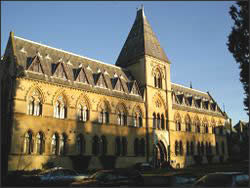
Oxford University Museum
of Natural History
|
The prestige of Oxford is seen in
the fact that it received a charter from King Henry
II, granting its citizens the same privileges and exemptions
as those enjoyed by the capital of the kingdom; and
various important religious houses were founded in or
near the city. A grandson of King John established Rewley
Abbey for the Cistercian Order; and friars of various
orders (Dominicans, Franciscans, Carmelites, Augustinians,
and Trinitarians), all had houses at Oxford of varying
importance. Parliaments were often held in the city
during the thirteenth century, but this period also
saw the beginning of the long struggle between the town
and the growing university which ended in the subjugation
of the former, and the extinction for centuries of the
civic importance of Oxford."
The University of Oxford is first mentioned in 12th
century records. Oxford's earliest colleges were University
College (1249), Balliol (1263) and Merton (1264). These
colleges were established at a time when Europeans were
starting to translate the writings of Greek philosophers.
These writings challenged European ideology – inspiring
scientific discoveries and advancements in the arts
– as society began seeing itself in a new way.
These colleges at Oxford were supported by the Church
in hopes to reconcile Greek Philosophy and Christian
Theology."
| |
|
|
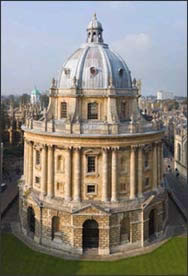
The Radcliffe Camera
|
| |
| |
Christ Church Cathedral, Oxford
is unique as a college chapel and cathedral in one foundation.
Originally the Priory Church of St Frideswide, the building
was extended and incorporated into the structure of
the Cardinal's College shortly before its refounding
as Christ Church in 1546, since which time it has functioned
as the cathedral of the Diocese of Oxford."
The relationship between "town and gown" has
often been uneasy — several university students
were killed in the St Scholastica Day Riot of 1355."
During the English Civil War, Oxford housed the court
of Charles I in 1642, after the king was expelled from
London, although there was strong support in the town
for the Parliamentarian cause. The town yielded to Parliamentarian
forces under General Fairfax in 1646."
In 1790 the Oxford Canal connected the city with Coventry.
The Duke's Cut was completed by the Duke of Marlborough
in 1789 to link the new canal with the River Thames;
and in 1796 the Oxford Canal company built their own
link to the Thames, at Isis Lock. In the 1840s, the
Great Western Railway and London and North Western Railway
linked Oxford with London."
Oxford's Town Hall was built by Henry T. Hare, the foundation
stone was laid on 6 July 1893 and opened by the future
King Edward VII on 12 May 1897. The site has been the
seat of local government since the Guild Hall of 1292
and though Oxford is a city and a Lord Mayoralty, it
is still called by its traditional name of "Town
Hall"."
| |
|
|
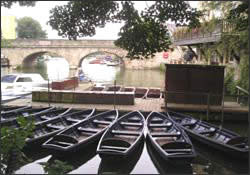
Folly Bridge in Oxford
|
By the early 20th century, Oxford
was experiencing rapid industrial and population growth,
with the printing and publishing industries becoming
well established by the 1920s. Also during that decade,
the economy and society of Oxford underwent a huge transformation
as William Morris established the Morris Motor Company
to mass produce cars in Cowley, on the south-eastern
edge of the city. By the early 1970s over 20,000 people
worked in Cowley at the huge Morris Motors and Pressed
Steel Fisher plants. By this time Oxford was a city
of two halves: the university city to the west of Magdalen
Bridge (from where students traditionally jump into
the River Cherwell every May Day morning) and the car
town to the east. This led to the witticism that "Oxford
is the left bank of Cowley". Cowley suffered major
job losses in the 1980s and 1990s during the decline
of British Leyland, but is now producing the successful
New MINI for BMW."
The influx of migrant labour to the car plants, recent
immigration from south-east Asia, and a large student
population, have given Oxford a notable cosmopolitan
character, especially in the Headington and Cowley Road
areas with their many bars, cafes, restaurants, clubs,
ethnic shops and fast food outlets."
On 6 May 1954, Roger Bannister, as a 25 year old medical
student, ran the first authenticated sub-four minute
mile at the Iffley Road running track in Oxford."
Oxford's second university, Oxford Brookes University,
formerly the Oxford School of Art, based on Headington
Hill, was given its charter in 1991 and has been voted
for the last five years the best new university in the
UK.
|